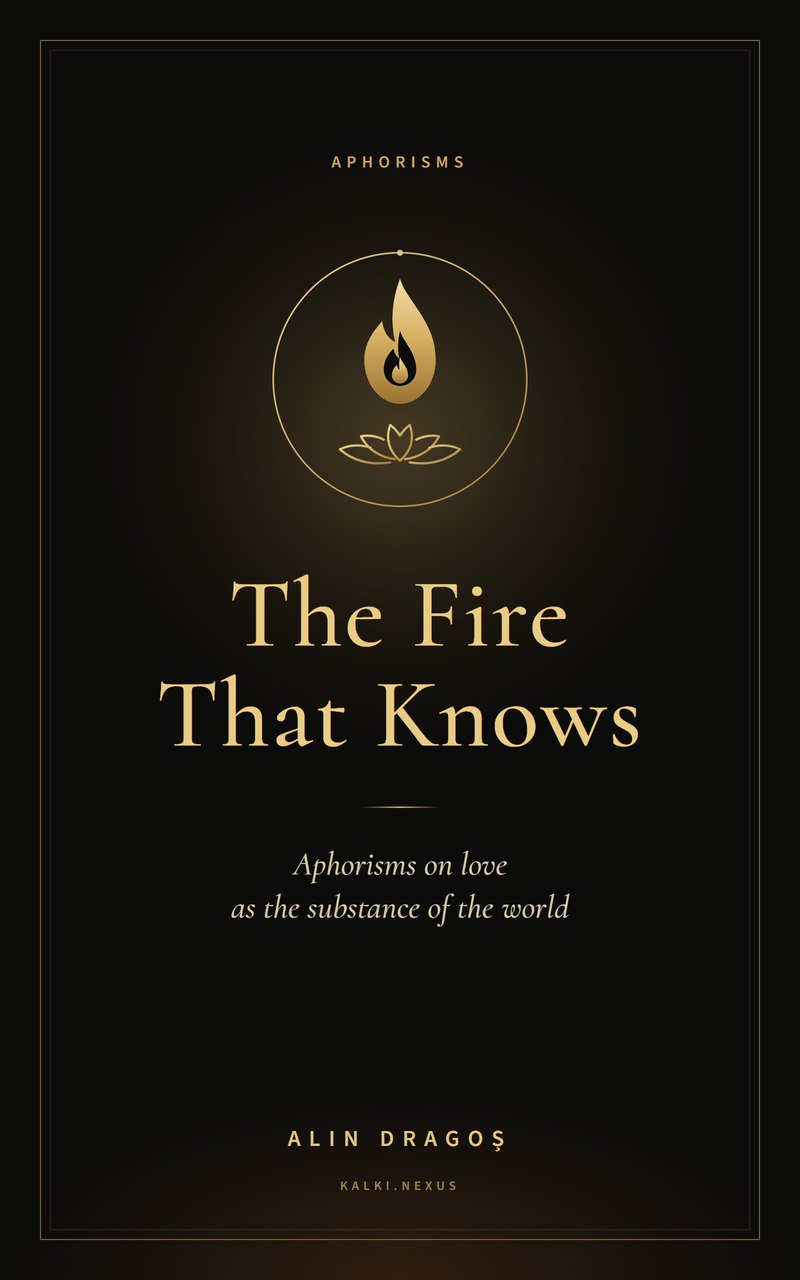
Cover of the book “The Fire That Knows”, by Alin Dragoș

New book · Aphorisms

The Fire That Knows

Aphorisms on love as the substance of the world

Alin Dragoș · 341 aphorisms · PDF · English

"The Fire That Knows" is a book of 341 aphorisms on love. Not love as a passing feeling or as a subject for psychology, but love as the substance of the world: what binds two people, what binds the living to those who have gone, and what, in the end, binds a human being to the One. The book does not try to explain love. It tries to show, here and there, the place where it happened.

The digital edition (PDF) will be available for purchase here soon. Until then, read the beginning for free.

Read the beginning for free
“Love is not learned. It is only remembered.”
“Shared silence is the highest degree of conversation.”
“Close the book. Love. That is all that remains to be done.”

About the book

The idea that runs through the whole book is old and simple: in the beginning there was the One, and the One split in two. Since then, everything that is separate longs for what it has lost. In this light, the love between two people is more than a happy accident. It is a memory. "Love is not learned. It is only remembered."

The road of the book follows this memory step by step. It begins with the gaze that makes the other real, passes through meeting, longing, body, word and wound, pauses at the shadows of jealousy, at the time of those in love and at those who are no longer here. Then it opens toward a love that asks nothing in return and ends where it began: at the One.

It is not a book of advice and not a treatise. Each aphorism stands alone, like a candle lit in a dark room. Together, they light a road.

The book speaks in several spiritual languages, convinced that the maps are many and the territory is one.

Hermeticism, the tradition attributed to Hermes Trismegistus, offers the basic principle: "as above, so below". What happens between two people mirrors, on a small scale, what happens in the cosmos.

Tantra, from India, speaks of Shiva and Shakti, consciousness and energy, two polarities whose reunion is love itself. In the book's reading, tantra is not a collection of techniques but the reminder that the body is a temple and that touch can be prayer.

Bhakti, the path of devotion in the Indian tradition, brings two precious words: viraha, the longing for the Divine, sometimes held to be deeper than the meeting itself, and prema, pure love, without expectation.

Christian mysticism comes with the Song of Songs, with the idea that love is stronger than death, and with that "herida deliciosa", the sweet wound the Spanish mystics spoke of.

Plato, in the Symposium, preserves the myth of Aristophanes: people were once whole, they were cut in two, and ever since they have been searching for each other. And the Romanian dor, the word the book calls "the Romanian name for divine absence", gathers all these searches into a single syllable.

The book has a prologue, twelve chapters and an epilogue: 341 aphorisms in all. Each chapter opens with a motto and follows a single theme, and the order of the chapters forms an arc, from the original separation to the finding again.

The aphorisms can be read in order, as a road, or opened at random, one a day. Both readings are fitting. The prologue says it plainly: "The aphorism is the form of language closest to silence."

The book names its own reader, in the epilogue: "This book is not for those who love. They do not need it. It is for those who have not yet dared, or for those who have forgotten."

It is, then, for anyone who has felt at least once that love is more than a feeling and has wanted to understand where this suspicion comes from. It asks for no knowledge of philosophy or religion. It asks only for the willingness to read slowly.

If you want to begin, open the prologue and read a single aphorism. Let it stay with you for a day. The rest of the book is waiting.

Who it is for

The book names its own reader, in the epilogue: "This book is not for those who love. They do not need it. It is for those who have not yet dared, or for those who have forgotten."

Contents

  1. Prologue

    Before the Word

    Why one writes about love, and why only in aphorisms. The word comes after the thing, and the book does not want to explain love, only to show the place where it happened.

    12 aphorisms
  2. Chapter I

    The Two Who Were One

    The myth of the original separation, from Hermeticism and tantra to Plato's Symposium. Love appears as remembrance: two who recognize their lost unity.

    28 aphorisms
  3. Chapter II

    The Gaze That Creates

    The loving gaze makes real what it sees. On attention and love as the same thing spoken in two registers, and on the gift of telling someone that they have the right to exist.

    27 aphorisms
  4. Chapter III

    The Meeting

    True meetings do not feel like chance events but like recognitions. The other meets the one you were going to become, and the life lived until then gains meaning in hindsight.

    26 aphorisms
  5. Chapter IV

    Dor — The Romanian Word for Longing

    Dor as the presence of the absent one and as the Romanian name for divine absence. The chapter sets it beside viraha from the bhakti tradition and beside its Latin etymology.

    28 aphorisms
  6. Chapter V

    The Skin and the Soul

    Eros as the concrete form of the spirit. Touch, embrace and kiss seen as applied metaphysics, in the light of tantra and alchemy.

    27 aphorisms
  7. Chapter VI

    The Word Spoken Between Two

    On the words that change two lives and on the silence that only two can keep together. Love needs both, alternated with measure.

    26 aphorisms
  8. Chapter VII

    The Blessed Wound

    Suffering in love as an opening, not a punishment. On vulnerability, on the alchemists' nigredo and on the gentleness that comes from pain accepted.

    27 aphorisms
  9. Chapter VIII

    Jealousies and Phantoms

    The shadows that accompany the light: jealousy as fear in disguise, possession that suffocates, and the freedom that makes the other stay by choice.

    27 aphorisms
  10. Chapter IX

    The Time of Those in Love

    Love changes our relationship with time. Eternity is not time prolonged but time deepened, and the only moment in which you can love someone is now.

    26 aphorisms
  11. Chapter X

    On Those Who Are No Longer Here

    Love that passes through death is not lost but transformed into inner presence. On grief, memory and a conversation that continues in another register.

    27 aphorisms
  12. Chapter XI

    Love Without Object

    A love that does not ask to be returned: agape, caritas, ishq, prema. The love that no longer needs a reason and that, for that very reason, cannot be taken away.

    26 aphorisms
  13. Chapter XII

    The Return to the One

    The end of the road: the two discover that they are the same. Not through merging but through recognition, until all that remains is a silence that loves.

    27 aphorisms
  14. Epilogue

    After the Word

    Words about love are shadows, and love is the light. The book completes its task by sending its reader back to love.

    7 aphorisms

The digital edition (PDF) will be available for purchase here soon. Until then, read the beginning for free.

Read the beginning for free