Kalki Nexus · Culture and spirituality
No one is in a hurry here.
A place of spirituality and an inspiring vision of culture.
The next step begins in silence.
Books, word, sound and a few minutes of stillness.
Kalki Nexus · Culture and spirituality
No one is in a hurry here.
A place of spirituality and an inspiring vision of culture.
Manifesto
A place, not a promise
Kalki Nexus is a place of spirituality and an inspiring vision of culture. It is not a school, not a movement and not a doctrine. It is a quiet space where you can read a few short books, listen to a few pieces of music and spend a few minutes in silence. It was born from a simple refusal: the refusal to go on living scattered in a hundred directions. Everything you find here has one purpose: to help you settle on the inside.
Read the manifesto →Aphorism of the day
Stay a moment
Press and hold the button. The thought clears slowly, like a fire catching.
The library
Five books, one road
Short books, to be read slowly: aphorisms, parables, letters and essays about the person who no longer contradicts themselves.
I
New book · Aphorisms
The Fire That Knows
Aphorisms on love as the substance of the world
"The Fire That Knows" is a book of 341 aphorisms on love. Not love as a passing feeling or as a subject for psychology, but love as the substance of the world: what binds two people, what binds the living to those who have gone, and what, in the end, binds a human being to the One. The book does not try to explain love. It tries to show, here and there, the place where it happened.
“Love is not learned. It is only remembered.”
The digital edition (PDF) will be available for purchase here soon. Until then, read the beginning for free.
Buy the digital edition · Read the beginning for freePayment is processed by Stripe; we never see your card details. You receive the download link immediately and the invoice by e-mail. The price includes VAT.
Is this yet another self-help book?
No. It gives no recipes and promises nothing. It is 341 aphorisms, to be read one a day, slowly.
Can I see how it is written before buying?
Yes. The prologue and the first chapter are free, with the “Read the beginning for free” button.
How do I receive it after payment?
Immediately, on the thank-you page, as a PDF. The link stays valid and the invoice arrives by e-mail.
Is the payment secure?
Payment is processed by Stripe. We never see or store your card details.
II
Parables
The Immortal Light
The Teacher's Edition · 55 parables
The Immortal Light sets the great religious traditions of the world side by side and lets each of them speak in turn about the things that cannot be avoided: God, love, suffering, consciousness, death. It does not compare them in order to choose one, and it does not blend them into a single teaching. The differences stay where they are; the book listens for what can be heard beyond them.
“A copied story is a dead story: to live, it has to pass through someone, and whoever it passes through leaves marks on it.”
The digital edition (PDF) will be available for purchase here soon. Until then, read the beginning for free.
Buy the digital edition · Read the beginning for freePayment is processed by Stripe; we never see your card details. You receive the download link immediately and the invoice by e-mail. The price includes VAT.
III
Essay
The Sword and the Hearth
An essay on the five circles
In the autumn of 1645, Miyamoto Musashi, a swordsman who had fought some sixty times without losing, climbed into a cave on Kyūshū and wrote a short book divided into five: Earth, Water, Fire, Wind, Void. The Sword and the Hearth starts from it, but it is neither a translation nor a scholarly commentary. It is an essay that reads the five circles as an anatomy of attention: how a person stands, how they look, how they begin, how they tell things apart, and how they work once they have stopped watching themselves.
“What has been lost since is neither of them. It is their nearness.”
The digital edition (PDF) will be available for purchase here soon. Until then, read the beginning for free.
Buy the digital edition · Read the beginning for freePayment is processed by Stripe; we never see your card details. You receive the download link immediately and the invoice by e-mail. The price includes VAT.
IV
Letters
Harmony
Letters on the best form of yourself
Twenty-one Stoic letters, in the shadow of Seneca, about the best form of yourself. Not the strongest and not the most admired, but the form in which you no longer contradict yourself. It is the most practical of the four books: it speaks about time, about giving, about measure, and about the agreement between thought, word and deed.
“The best form of yourself is not the strongest, nor the most admired, nor the richest. It is the form in which you no longer contradict yourself.”
The digital edition (PDF) will be available for purchase here soon. Until then, read the beginning for free.
Buy the digital edition · Read the beginning for freePayment is processed by Stripe; we never see your card details. You receive the download link immediately and the invoice by e-mail. The price includes VAT.
V
Essay
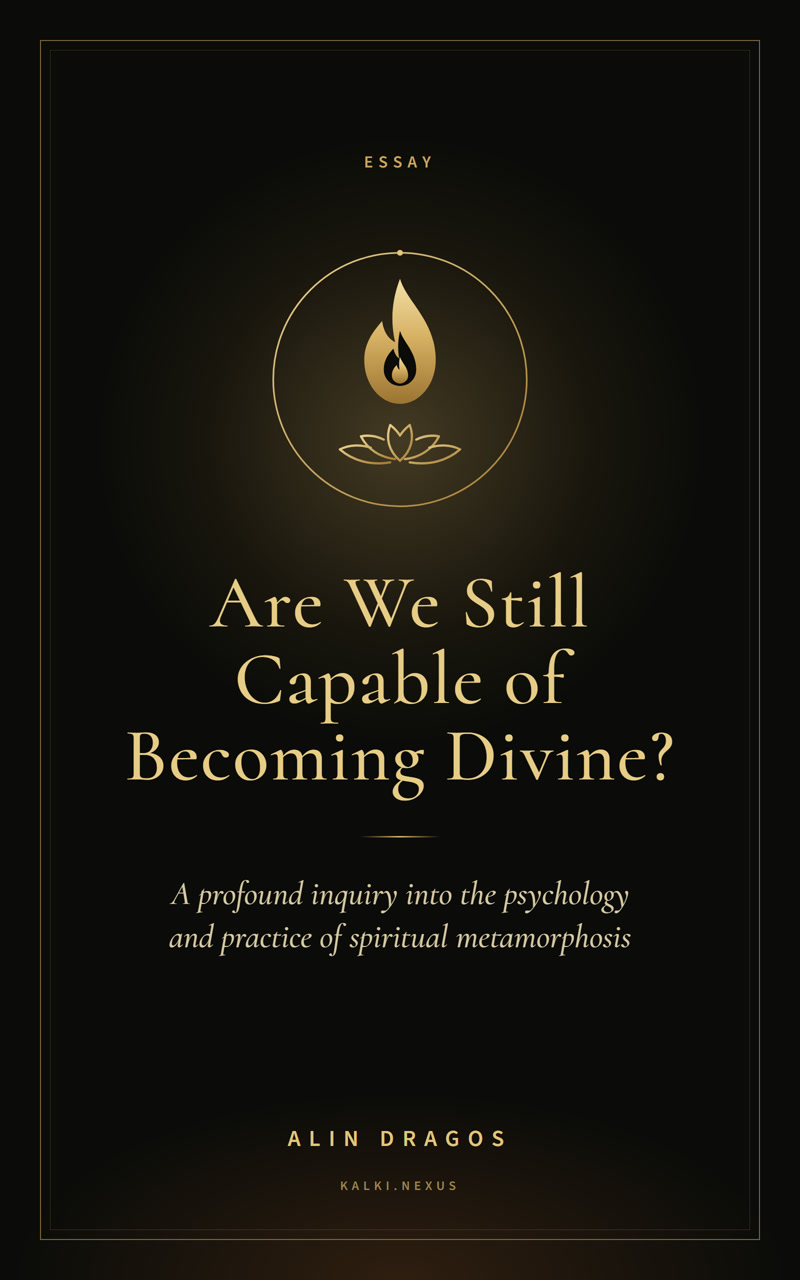
Are We Still Capable of Becoming Divine?
An essay
The book begins with a diagnosis: surrounded by ever more intelligent tools, the person of today is losing the capacity to be alone with themselves, to pay attention, and to ask who they are. The author calls this loss forgetting and sets against it an old word, theosis, the deification of the human being, as Athanasius the Great formulated it and as it appears, under other names, in Hinduism, Buddhism, Sufism and Hermeticism.
“This book is not a consolation. It is not a self-help manual in the commercial sense of that phrase. It is, in its essence, a diagnosis. And after the diagnosis, a map.”
The digital edition (PDF) will be available for purchase here soon. Until then, read the beginning for free.
Buy the digital edition · Read the beginning for freePayment is processed by Stripe; we never see your card details. You receive the download link immediately and the invoice by e-mail. The price includes VAT.
Word and sound
Meditative verses, set to music
Ten pieces. Nothing starts on its own: you choose when to listen. For the background, the “Background sound” button in the corner of the page starts a quiet loop with theta and alpha frequencies, best felt with headphones.
On listening →The sanctuary of stillness
The Clock of Silence
Choose a duration, press Start and let the screen empty itself. Nothing else to do.
Why silence →